Cedar

AI built for economic analysis, from the beginning.

Cedar is Lumecon’s AI economic analyst. It works across intake, analysis, interpretation and reporting, helping turn organizational knowledge and source documents into usable economic analysis. Not a chatbot added to old software. Part of how Lumecon works.

The Cedar panel open over a Lumecon results page, writing a board-ready summary of jobs, output, GDP contribution, labor income and tax impacts.
Cedar working inside a live analysis, shown with sample data.

AI shouldn’t sit on top of the model.

The common pattern bolts an assistant onto finished software: the data goes in, the model runs, the results come out, and a chatbot answers questions about them afterward. Cedar participates throughout the workflow instead: reading source material, structuring inputs, surfacing gaps, supporting interpretation and helping communicate findings.

Bring the work you already have.

Your existing work becomes context, not baggage. Upload supported PDFs, spreadsheets, CSVs, prior studies and recurring organizational materials. Cedar helps identify the relevant information and map it into the analysis workflow, and it flags the gaps it cannot resolve rather than papering over them.

Moving from another platform? Prior studies and reporting examples help Cedar understand how your organization already works: the terminology you use, the geographies you care about and the format your reporting takes.

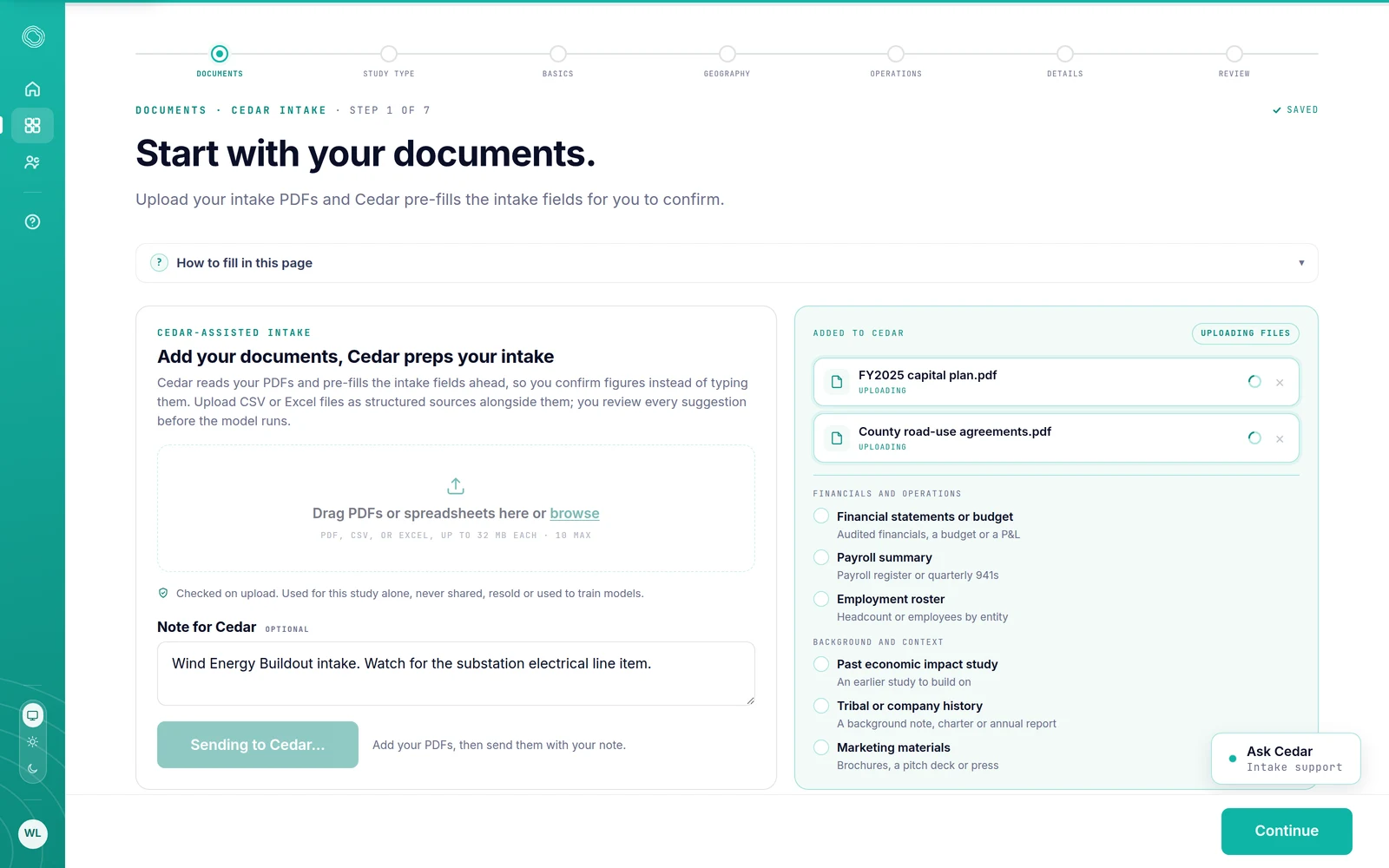
The first step of a new analysis: two PDFs, a capital plan and county road-use agreements, uploading to Cedar with live per-file status, alongside a note telling Cedar to watch for the substation electrical line item.
Where every analysis starts: the wind study’s source documents uploading to Cedar, with a note about what to watch for. Shown with sample data.
A wind energy buildout analysis with the Cedar panel reporting on three uploaded documents: a capital plan with nine construction phases mapped to model operations, a turbine procurement workbook with costs and labor separated, county road-use agreements used to place activity, and one flagged gap to resolve.
The same documents after Cedar has read them, on the finished analysis: what it mapped, what it used as context and the gap it flagged for review. Shown with sample data.

One Cedar. Your organization.

Cedar can carry approved organizational context across projects, helping teams build on prior work rather than starting from zero each time. For larger organizations, Cedar can be calibrated around terminology, recurring workflows, analytical conventions and reporting preferences, and Cedar Grove on the Tree plan gives that context a durable home.

Thought partner, not autopilot.

Cedar can suggest, question, organize, explain and draft. It can help an analyst explain the same finding differently for a board, a policymaker, a tribal council, a grantmaker or an executive. It does not remove the analyst from the work: Cedar surfaces the assumptions it makes, and the person running the analysis confirms them before results are finalized. AI in the workflow. Economists in the loop.

The same wind energy analysis, with Cedar drafting a county-board summary that draws on the results and the three documents uploaded earlier: the capital plan, the turbine procurement workbook and the road-use agreements.
The same analysis, later in the work: Cedar drafts the county-board summary from the results and the documents it read at intake. Shown with sample data.

Economics isn’t handed to engineering after the fact.

Lumecon is developed collaboratively across economics, social science, data science and software engineering. Modeling decisions shape the software. New data changes what can be estimated. Software and AI make new analytical workflows possible.

That is why Cedar behaves like part of the analysis rather than a layer over it:the model, data infrastructure, software and AI evolve together.

AI shouldn’t just make the software easier. It should help us build better models.

Modern AI makes larger and more varied datasets practical to process, harmonize, classify and validate. That helps Lumecon expand the evidence available to the model, including alternative and higher-frequency sources where they improve the analysis. The economics of the model stay grounded in the documented methodology; what grows is the evidence behind it.

Your work stays yours. The system can still improve.

Customer proprietary source material is not made available to other organizations. Improvements to Lumecon’s processing and modeling can be informed by aggregated or appropriately processed information without exposing another customer’s underlying data.

You benefit from a platform that keeps learning without sharing another organization’s proprietary work. The privacy policy governs the details.

Built to use the best tools available.

Cedar’s architecture is designed to take advantage of leading AI capabilities as the field improves, rather than tying Lumecon’s product to a single model generation.

Cedar isn’t finished. Neither are the data, models or methods.

We are continually expanding the formats Cedar can understand, the workflows it can support, the context it can use and the ways modern data can strengthen economic analysis. The model should improve as the evidence improves. So should the software around it.