Cedar Commons

An analysis is finished by more than one person.

The payroll figures sit with finance. The headcounts sit with operations. Whether either can leave the building at all sits with somebody else again. Cedar Commons is where those people join the analysis that needs them, each reaching the one project they were invited to and nothing else.

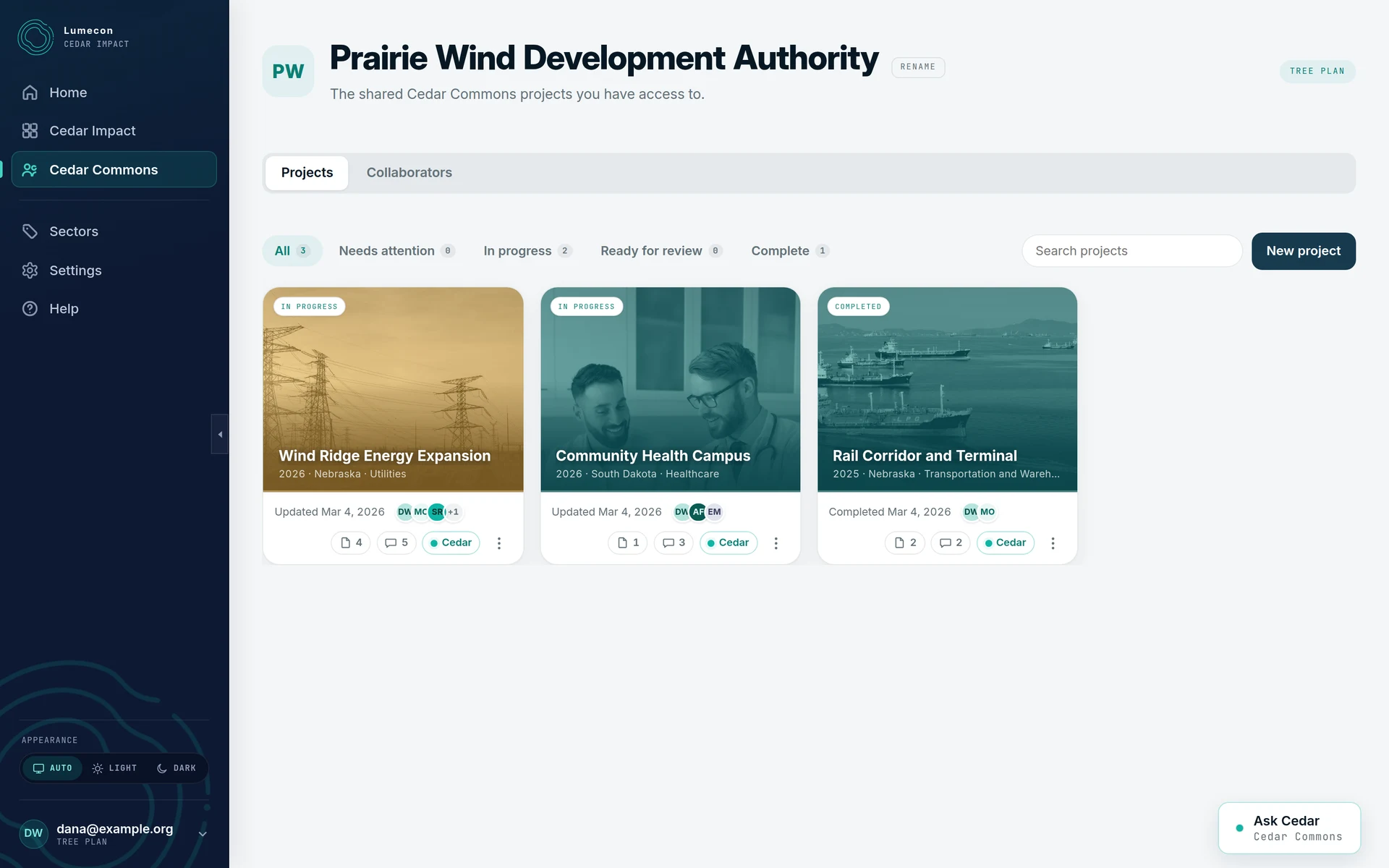
The Cedar Commons board: three shared analyses, each carrying its status, the people on it and the records and notes it holds. Shown with sample data.
The analyses an organization is working on, in one place. Shown with sample data.

Who can see what

Access is granted project by project, never organization-wide. Two things decide it, and they are independent of each other.

Internal or externalWhose organization they belong to
Internal is someone working for or on behalf of the organization sponsoring the analysis. External is a client, a partner or an outside advisor. An external collaborator reaches the one project they were invited to and nothing else in the organization.
Owner, collaborator or viewerWhat they can do on that project
The owner adds someone by email and decides what they may do. A collaborator contributes. A viewer reads and changes nothing. The same person can be a collaborator on one project and a viewer on another, and the roster reports it per project rather than averaging it into one label.

Two shapes of project team

The records are spread across your own offices.

Finance holds one set, the enterprises hold others, and a board member or outside counsel may need to read the result without touching it. Four staff here, two outside people, and each outside person is bound to the single project they were brought in for.

The records belong to someone who is not you at all.

A consultant opens a project per engagement and brings that client’s finance and operations people into it, and only into it. One client’s contacts never see another client’s work, and a project the client does not own names the organization sponsoring it, so nobody is unsure whose subscription is paying.

An organization’s collaborator view: four internal people with their permissions, and two external people, each listed with the one project they can reach. Shown with sample data.
Prairie Wind, on Tree. The external roster names the project beside each person, so the boundary is readable rather than assumed. Shown with sample data.
A consultancy’s collaborator view: one internal person and three client contacts across two different clients, each listed with the single project they can reach. Shown with sample data.
Ferreira, on Sapling. Three client contacts from two clients, four of ten seats in use — an outside collaborator occupies a seat, the same as a colleague. Shown with sample data.

They bring the records you do not hold.

A record lands on the project rather than in one person’s library, carrying who added it and when. Everyone on the project sees what is already there, so nobody sends the payroll summary twice, and a figure questioned a year later still has the file it came from beside it.

The records panel on a shared analysis, listing four spreadsheets contributed by three different people, each with the contributor, the date, the size and its state. Shown with sample data.
Four records on one analysis, from three people. Shown with sample data.

Before you invite anyone

The three questions people ask before they let a colleague, a client or an auditor near their own records.

Reading

A viewer changes nothing

Read-only is a permission, not a convention. A viewer sees the analysis, the records and the thread, and the routes that add to any of them refuse them.

Recording

A note is kept, not edited

What was said about an assumption stays as it was said. The thread is a record of the decision rather than of what someone later wished the decision had been.

Paying

An outside collaborator occupies a seat

A seat is a person, not a job title, so a client contact counts the same as a colleague. Sapling is ten people in one organization however they are split; Tree has no limit.

Working with a consultant? Share the starting guide with them, or begin a project together in Lumecon.

Included, not sold separately

Cedar Commons comes with Sapling and above.

There is no separate Commons purchase and nothing here is an add-on. The difference between the plans that include it is how many people can be in your organization, not how much of the workspace you get.

The starting guide helps you prepare: the first question, the records, and who can approve sharing them. This is where that work happens once you have.

  • Seed $0 / yearNot included1 user
  • Sprout $1,000 / yearNot included1 user
  • Sapling $2,500 / yearIncluded. Shared projects, project notes, data collection and outside collaborators.Up to 10 users
  • Tree $7,500 / yearIncluded across the organization.Unlimited users in one organization